10 hr
Santo Antão Island Discovery with Local Guide
Ferry across to Cape Verde's greenest island for a full-day exploration of volcanic craters, mountain villages, and lush valleys
Reserve
Hand-picked by our editors — only the best 5 experiences from 12 reviewed.
Verified partners for every tour, free cancellation where available, and instant confirmation on every booking.
10 hr
Ferry across to Cape Verde's greenest island for a full-day exploration of volcanic craters, mountain villages, and lush valleys
Reserve
11 hr
Explore Cape Verde's greenest island on an 11-hour adventure through volcanic craters, mountain roads, and coastal villages
Reserve
7 hr
Explore volcanic craters, coastal villages, lush valleys, and sample traditional rum on this scenic island adventure
ReservePrices from verified partners. Availability updates in real time at checkout. Free cancellation policies apply where shown.
They complement each other; most travelers find that an organized sao antao day trip offers superior local context, while independent ferry exploration provides greater personal autonomy. Choosing between a structured sao antao day trip tour and a self-led journey depends on your preference for curated mountain logistics versus spontaneous discovery of the archipelago.
| Feature | Top pick Guided Day Trip | Independent Exploration |
|---|---|---|
Logistics |
Pre-arranged transport included | Requires ferry and local taxi coordination |
Local Knowledge |
Expert guide narrative provided | Self-guided research necessary |
Flexibility |
Fixed itinerary structure | Full control over schedule |
Cost Structure |
Inclusive of sao antao day trip tickets | Paid per individual service (summer) |
Pace |
Scheduled group movement | Self-determined exploration speed |
Language Barriers |
Multilingual support available | Requires basic Portuguese or French |
| See tickets → |
Verdict: Opt for a professional sao antao day trip tours provider if you prioritize cultural insights and seamless mountain transit over the unpredictable nature of independent travel.
Choose your ticket, select your date, and reserve in under two minutes. Secure checkout handled by our verified partner.
Instant confirmation by email, with a mobile voucher you can save offline. No printing, no queuing at a collection desk.
Arrive at the entrance, show your voucher on your phone, and walk in. Most tickets include priority or skip-the-line access.
Practical details for your visit straight from our verified partners — hours, access, rules, and how to get there.
Garemaritima, Porto Novo
Look for your guide holding a name sign
Daily crossings connect Mindelo to Porto Novo in approximately 60 minutes.
Sturdy, closed-toe hiking shoes are essential for exploring the rugged terrain of a sao antao day trip. Dress in layers, as temperatures can vary significantly between the coast and high-altitude mountain regions.
Keep baggage light, as most transport during a sao antao day trip involves shared vans or narrow mountain paths. Secure your valuables, as there are no public lockers available for day visitors.
Photography is encouraged throughout your sao antao day trip, especially at viewpoints like the Cova Crater ridge. Always respect local privacy when photographing villages or residents.
Many locations on a sao antao day trip are naturally rugged and not wheelchair accessible. Visitors with limited mobility should consult local guides to plan routes that avoid steep, uneven mountain trails.
Mobile signal is available in major towns like Porto Novo and Ribeira Grande but may be limited in deep valleys during a sao antao day trip. Download offline maps before beginning your mountain transit.
Family-friendly options exist, but a sao antao day trip can be physically demanding for very young children. Plan for shorter walks and ensure adequate sun protection for all ages.
Traditional restaurants are scattered across the valleys and villages visited during a sao antao day trip. Bringing a reusable water bottle is recommended, as mountain air can be quite dry.
Pets are generally not permitted on shared transport used for a sao antao day trip. Check with private drivers if you intend to bring an animal on a chartered excursion.
A sao antao day trip is best managed by booking local transport or professional guides in advance. The ferry from São Vicente remains the only entry point to the island.
Garemaritima, Porto Novo
Look for your guide holding a name sign
Get directionsBest time to go, insider tips, nearby landmarks, and the cancellation fine print — flip through to skim what matters to you.
How crowds, weather, and events shift across the year.
The primary dry season offers the most reliable weather for hiking across the island's interior. Temperatures are generally cooler and more comfortable for outdoor exertion.
Small details that turn a good visit into a great one.
Ferry tickets for a sao antao day trip should be secured a day in advance.
Non-bookable sights within a short walk — free to visit, easy to pair.
A massive volcanic crater now used for agriculture and panoramic viewing.
Flexible, no hidden fees.
Cancellation policies for a sao antao day trip vary by operator, but most offer full refunds for cancellations made at least 24 hours in advance. Entrance fees are 0 CVE as there is no island-wide admission fee.
Hand-picked options within walking distance — pick a district for vibe, or a specific hotel for convenience.
Well-regarded stay in the green valleys
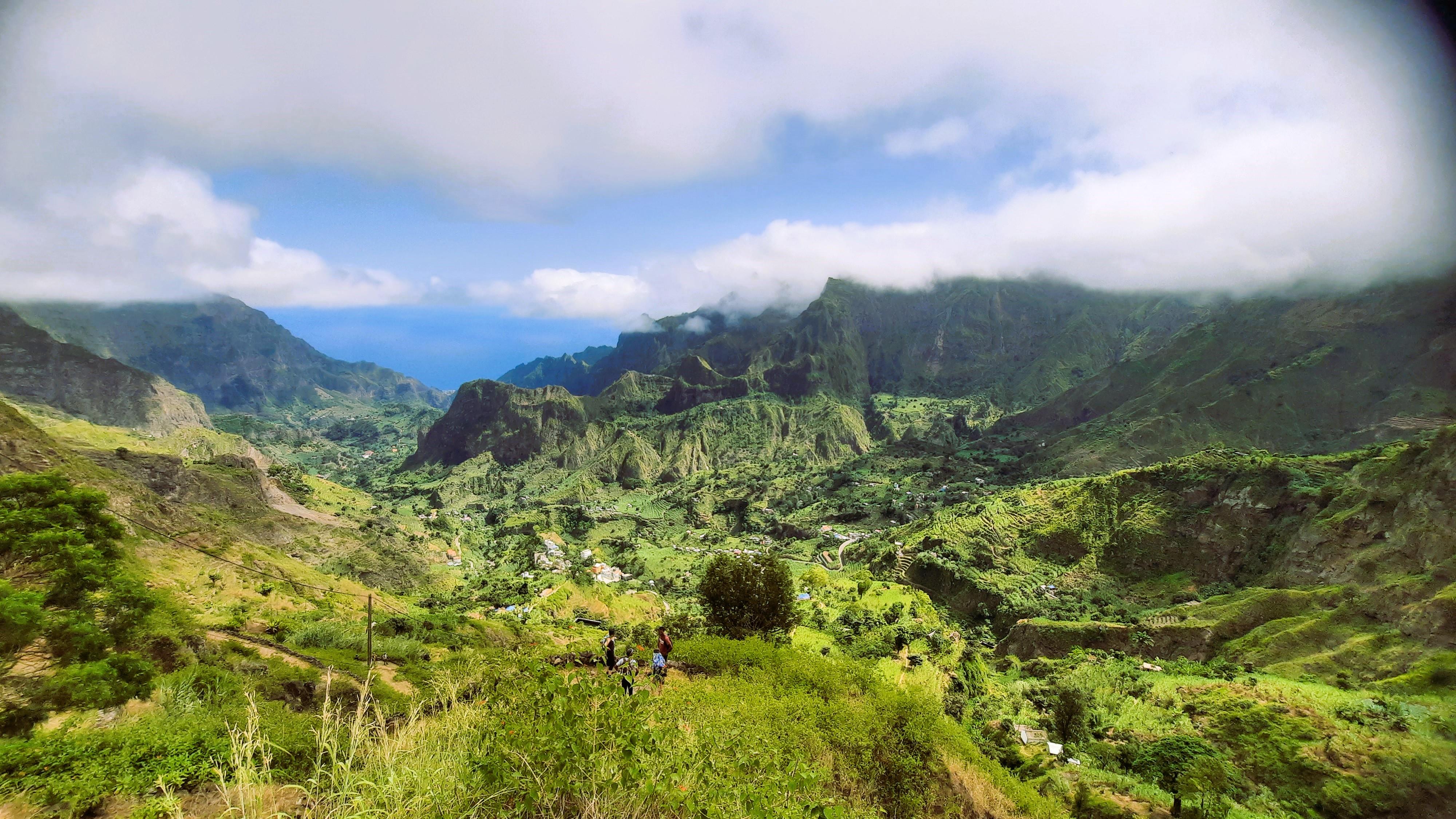
Santo Antão rises 1,979 metres from the Atlantic, its spine a jagged cordillera of volcanic peaks that trap clouds and channel rain into verdant valleys invisible from the coast. The island receives no ferry terminal capable of handling commercial cargo — all visitors arrive by passenger catamaran from São Vicente, a 40-minute crossing that has shaped Santo Antão's economy and ecology for generations. Without a port deep enough for container ships, the island imports nothing in bulk, and agriculture remains subsistence-scale: terraced plots of sugarcane, cassava, and banana cascade down ribeiras watered by levadas, the hand-cut irrigation channels that thread cliffsides and deliver runoff from the high plateau to the valleys below. The Cova Crater, a collapsed caldera at 1,166 metres, marks the island's climatic divide. Clouds streaming from the northeast condense against the crater rim, then spill into the Ribeira do Paúl, a nine-kilometre gorge that descends through microclimates — pine and acacia at the pass, banana and papaya at sea level. The Portuguese colonial administration cut a cobbled trail into the valley floor in the 19th century to extract sugarcane; that trail, now widened to a dirt track navigable by four-wheel drive, remains the only overland route between the island's northern and southern halves. The Paul Valley produces aguardente, a cane spirit distilled in copper stills inherited from colonial mills, and grogue, the unaged variant that fuels local festivals and maritime trade. Santo Antão's isolation has preserved Cabo Verdean Creole dialects and farming techniques rare elsewhere in the archipelago. The island's western coast is desert — basalt plains and salt pans where goats outnumber people. The eastern valleys, by contrast, sustain 15 villages, none larger than 800 residents, connected by footpaths that predate roads. The ferry schedule governs daily life: boats depart Mindelo at 07:00 and return at 16:00, a rhythm that compresses a São Antão day trip into eight hours of road switchbacks, crater overlooks, and valley descents. Local guides, many of whom farm between tours, lead visitors through ribeiras still cultivated by hand, where terraces cling to slopes too steep for machinery and water rights are inherited, not sold.

"The ferry schedule governs daily life: boats depart Mindelo at 07:00 and return at 16:00, a rhythm that compresses exploration into eight hours of road switchbacks, crater overlooks, and valley descents."
A step-by-step walkthrough of the visit — what you'll see, how long each stage takes, and the details that matter.
You board the catamaran at Mindelo harbor before dawn, the ferry deck already crowded with islanders returning from São Vicente's market. The crossing takes 40 minutes; Santo Antão's black cliffs emerge from the haze as the boat rounds the breakwater at Porto Novo. On land, you transfer to a 4x4 — the island tour begins immediately, climbing switchbacks that gain 1,100 metres in 20 kilometres. The Cova Crater appears first as a pine-rimmed bowl, its floor a patchwork of maize and yam plots. Your guide pauses at the overlook, then descends into the Ribeira do Paúl. The road narrows, carved into cliff faces where mist clings to banana leaves and water trickles through levadas. You stop in a valley village to sample grogue at a family distillery, the copper still heated by sugarcane bagasse. The return leg follows the coastal road west, past basalt outcrops and fishing hamlets. You reach Porto Novo by 15:30, enough time to buy woven baskets at the quay before the ferry departs. The catamaran cuts back across the channel; Mindelo's harbour lights appear as the sun drops behind São Vicente.
Most natural sites on a sao antao day trip are open 00:00–23:59 as they are public outdoor areas.
There is 0 CVE entrance fee for a sao antao day trip; there is no island-wide admission charge.
You must take a ferry from São Vicente, which takes about 1 hour.
Baggage on a sao antao day trip should be kept to a small day pack for convenience.
Families can enjoy a sao antao day trip, though terrain is better suited for older children.
Yes, you can book a sao antao day trip tour through various local operators and platforms.
The best arrival window for a sao antao day trip is 07:00–16:00 to maximize daylight.
Photography is permitted throughout your sao antao day trip, provided you respect local residents.
Yes, your sao antao day trip allows for stops at traditional restaurants in villages like Paúl.